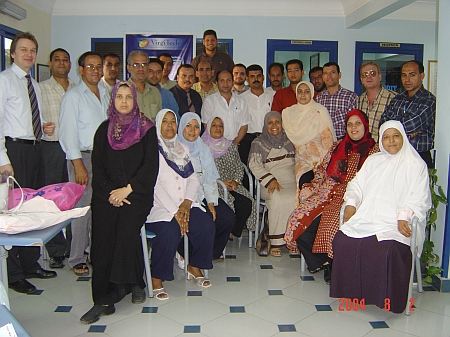
Through the Hoffmann & Reif workshops knowledge owners are enabled to become providers of added value services on the Internet, such as online publishers, eLearning tutors, or online community managers .
The deployment of eServices require new workflows and a high degree of collaboration between professionals from different subject matter areas. An organisational and cultural shift is required for those knowledge workers who are planning to offer eServices in the networked economy:
During the Hoffmann & Reif workshops these issues are addressed so that all the potentials of ICTs can be unleashed.
|
|||||||||
| Project Objectives The main objective of this workshop is a discussion on how to transfer lessons learnt from international, civil education projects to current education needs of the German Armed Forces while on missions abroad. |
|||||||||
| Scope and Results Participants from the German Armed Forces and international observers attended presentations and discussions. |
|||||||||
References/Links, Additional Files Congress homepage at Helmut Schmidt University (archive 2007)
Abstract (23KB)
Abstract: e-Learning in international economic development cooperation -- lessons learnt from staff development projects
DT Convention 2007 (170KB)
Distance Training Convention 2007: Conference Programme
Keynote (54KB)
Keynote of Prof. Dr. Thomson Sinkala / University of Zambia, "The relevance of distance education in developing country environments and the potential for military communities" |
|||||||||
|
|||||||||
| Project Objectives Each workshop participant develops an eLearning course and teaches online; participants apply newly acquired knowledge to their own teaching and training practice and perform the following tasks: to practise a Rapid E-Learning methodology for course-ware development and to develop a course module; to author a WebQuest document; to publish instructional content on an e-learning platform (course home page); to experience blended learning; to teach online; to use online evaluation tools. |
|||||||||
| Scope and Results 15 participants from 10 different countries attended this action- and result-oriented workshop; a preparatory phase took place a week before meeting face to face; during the one day face to face session participants produced e-learning content along the lines of a “Rapid eLearning Production” methodology and delivered there own course within a day. A game-based learning tool (yeepa) has been applied to assess the participants´ knowledge in groups. Skill development (e.g. tutoring skills) has been assessed by peers. |
|||||||||
References/Links, Additional Files Further information about the "The eLearning Quickstart Workshop" A two days hands-on workshop for teachers, professors, trainers and educational experts - available in English and German language Access to the Workshop Platform
Workshop Announcement (17KB)
Workshop Announcement, Online Educa Conference 2006
Pre-Conference Programme (1.5 MB)
Online Educa 2006: All Pre-Conference Forums, Workshops & Seminars [PDF] |
|||||||||
|
|||||||||
| Project Objectives High level experts from the European Commission and from established EU-African R&D projects present relevant aspects of the 6th and 7th EU R&D Framework Programmes, and discuss how to manage the consortium building process and submit successfully a proposal to the European Commission, how to forge consortia on two or three continents, and how to manage a European Commission funded R&D project from an African point of view. Participants present EU-African R&D proposal ideas and discuss them with the expert panel. |
|||||||||
| Scope and Results Workshop participants gain insights into the European Commission „Information Society Technologies“ and R&D programmes; are aware about the funding opportunities for African institutions and corporations offered under the new Euro-African partnership strategy framework, gain authentic information from existing European-African R&D projects, discuss their own possible contributions for future European-African R&D projects with European R&D stakeholders. |
|||||||||
References/Links, Additional Files |
|||||||||
|
|||||||||
| Project Objectives An action-oriented instructional content development workshop is delivered at Indira Gandhi National Open University on the occasion of the ICDE conference. University professors and teaching experts produce eLearning content along the lines of a “Rapid eLearning Production” methodology. Before the face to face session the team of coaches offer participants a short preparatory phase on the Internet. During the workshop, the participants themselves design eLearning course modules, with every individual result not only to be produced but also to be published on-the-fly on the Internet. |
|||||||||
| Scope and Results During a one day workshop participant get an orientation about the complete service chain, from instructional planning, development methodology until service delivery. |
|||||||||
References/Links, Additional Files eLearning Workspace Pre-Conference Workshop ICDE International Conference, New Delhi, India
Announcement (47KB)
Workshop Announcement, ICDE Conference
Agenda (31KB)
Workshop Agenda, Nov. 18th 2005
Slides (856KB)
Selected slides |
|||||||||
|
|||||||||
| Project Objectives A team of TVET teachers should be identified for blended learning service development; therefore, an assessment centre is conceptualized and implemented; according to portfolio assessment outcomes teaching staff is selected for developing and offering blended learning courses at a later stage; through the assessment centre participating teaching staff gain orientation knowledge about blended learning service development. |
|||||||||
| Scope and Results During a two day assessment centre teaching and management staff has been qualified and assessed; portfolio assessment methodology has been applied and led to the identification of a team of innovators. |
|||||||||
|
Screenshots and Photos |
References/Links, Additional Files National technical and vocational Education and training |
||||||||